


Blog / Bishop Toyota Service

Master the Pit Stop: How to Change a Tire on Your Toyota

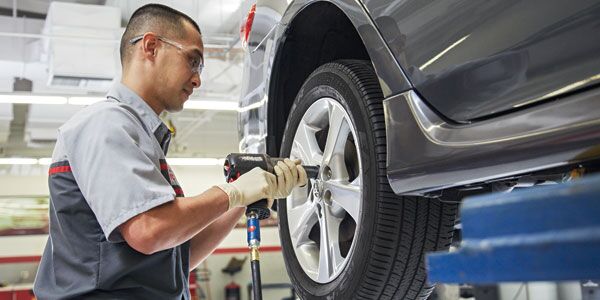
A Toyota technician changing a tire at Perry Motors Toyota in Bishop, CA

Changing a flat can look like a big problem, but it's easy if you follow a few simple steps. As your Toyota dealer, we want to tell you how to change a tire and get back on the road again in no time.

Find a Safe Place

The first step is to find a safe and flat place to change your tire. If your tire goes flat, you'll hear and feel this almost immediately. Look around you for a convenient place to pull over. You want to find somewhere as far from other moving vehicles as possible, as this prevents a possible accident and allows you to concentrate on fixing that tire.

Get Your Tools

There are only three things you need to change a tire: a spare tire, a jack, and a lug wrench. These items are usually located in your trunk, but if you don't find them there, your car manual will show you where they are. Once you've got your tools together, you're ready to tackle that flat.

Loosen The Lug Nuts

The lug nuts keep your tire firmly attached to the wheel hub, and they're tightly secured. Use the lug wrench to loosen each nut until you can turn it by hand. If the lug nuts won't move, connect the lug wrench to a nut and then push down on the wrench with your foot. This gives you extra leverage to force a stubborn nut to loosen.

Position the Jack

Look under your Toyota for a jack anchor point. These are flat sections of your car's frame that are designed for lifting your car. These points are placed behind each of your wheels.

Jack Your Car

Once you've found the anchor point, place the jack, and lift your car until the flat tire just touches the ground.

Remove the Flat

Unscrew each lug nut and put them to one side, then carefully lift the flat off the wheel hub.

Replace the Flat

Lift the spare tire onto the wheel hub. Once it's on the hub, rotate the spare until the holes in the hub match the holes in the spare. Replace the lug nuts and tighten them as securely as possible by hand.

Lower Your Car

Lower your car to the ground and remove the jack. Now use the lug wrench to securely tighten each nut until they don't move.

Replace the Tools

Now your tire has been changed, all that's left to do is place the flat, jack, and lug wrench back in their places and you're ready to leave. Once you've changed your tire, visit us at Perry Motors Toyota in Bishop, CA. We have all major tire brands in stock, and our technicians can supply you with a new tire.

Posted in:

Related Posts

A red Toyota Highlander

5 Reasons to Service Your Toyota at Your Toyota Dealership

Going for a service is an essential part of being a car owner, as you can maintain, fix, and diagnose issues with your vehicle. However, it does pose the question, should you visit an independent garage or head back to your Toyota dealers h ip for your service? Here are five service benefits you can expect to receive when visiting your Toyota car dealership. more 1. Use of Genuine Toyota Parts When you service your car at a Toyota car dealership, there is a guarantee that any parts or fluids that need replacing will be swapped out for genuine Toyota products. These parts and fluids will be manufacturer-approved, and made specifically for the model they are being used in. This will ensure they fit properly and will continue to operate safely and efficiently for a long time after the service. 2. Engineer Expertise In an independent garage, the engineers are likely to be generalists, often having a knowledge of how to operate on cars from a lot of different manufacturers. At a Toyota garage, the engineers will be specialists, with an in-depth understanding of how Toyota cars operate and run. This knowledge will also help them to diagnose problems that another engineer may fail to spot. 3. Service Records When you get your car serviced at the Toyota garage, it will be recorded in the database with the rest of your maintenance checks and services. This will provide an accurate picture of how your car has performed over time, as well as highlighting any issues that the engineers need to look out for. Having your services on record can also help you when it comes to selling your car. 4. Updating Software Most modern cars are reliant on software, whether it be for operating safety features, driver assistance, or the infotainment system. Toyota cars are no different, and will require maintenance checks to make sure all software is up to date. At a Toyota car dealership, the engineers will be able to perform these software checkups as part of your overall service. 5. Peace of Mind Getting your car serviced at an official Toyota garage will offer you peace of mind that your car is being operated on to a high standard. Toyota has built up a reputation for its commitment to quality and creating a positive customer experience. There is no guarantee that an independent garage can offer the same level of care and attention toward your Toyota vehicle. When you're planning on getting your Toyota serviced, you'll be met with plenty of options to consider. However, if you want the best expertise, use of manufacturer approved parts, and peace of mind, you'll be best served at a Toyota car dealership. Contact Perry Motors Toyota in Bishop, CA today to schedule your next service. Image via Toyota

A white Toyota RAV4

Essential Maintenance Tips: When to Service Your Toyota

Your Toyota requires regular services to keep it working at peak performance, and the required services are detailed in your car handbook. Sometimes, maintenance must be performed sooner than recommended due to driving conditions or excessive wear and tear on components. As your Toyota dealership, we'd like to give you some examples of essential Toyota maintenance we provide and the recommended mileage for replacement. Image via Toyota more Coolant Replacement Healthy coolant is vital for your engine, as it removes heat. The engine generates large amounts of the due to combustion, which must be removed to prevent damage to sensitive components like seals and gaskets. The coolant moves through your engine at high speed, absorbing heat as it goes, and transports the heat to the radiator, where it's removed by heat exchange. Coolant becomes less effective as it ages, and this will cause the engine temperature to rise. It usually requires replacement every 30,000 miles, but the correct replacement time for your Toyota is listed in your car manual. We'll drain and replace the coolant, and your engine temperature will drop to normal operating levels. Windshield Wiper Blades The windshield wiper blades are made from high-quality rubber. They're tough but flexible enough to clean the glass and gentle enough not to damage it. As time passes, the rubber will degrade due to UV rays, heat, cold, and rain. Older rubber loses flexibility, and this will cause it to crack instead of bend, and parts of the blades can break off. Blades usually need replacement every six months to one year, depending on their condition. Broken blades are less effective at keeping the windshield clean, leaving dirty patches behind and smearing the windshield. They can also scratch the glass, which can easily develop into a crack. Damaged blades can be quickly and inexpensively replaced, and the clear view will make driving safe again. Engine Air Filter Replacement The engine air filter traps dirt, dust, and other debris, preventing it from reaching your engine. The filter is housed in a small box inside the radiator grille, and air passes into it as you drive. The concertina-like filter's folds will eventually become clogged with dirt, greatly reducing the amount of air that can reach the engine. Combustion requires air and fuel and turns fuel-rich without sufficient air. This caused excessive wear on the spark plugs and can cause misfiring, or your Toyota could stall. In addition, most of the fuel used for combustion can't burn due to lack of air and is dumped out the tailpipe, reducing fuel efficiency. This filter is usually changed every 30,000 to 45,000 miles, depending on your model. If you'd like to know more about essential maintenance or to book a service, contact us at Perry Motors Toyota in Bishop, CA.

A black Toyota Highlander

Toyota Car Maintenance 101: Essential Tips for Upkeeping Your Toyota

Whether you own a Toyota car, truck, or SUV, regular maintenance is essential for its performance and appearance. If you need help figuring out how to care for your Toyota, we're here to assist you. The following is your guide to Toyota maintenance, with essential tips for keeping your vehicle in great shape. more Check the Fluids Your Toyota relies on several fluids to help it function properly. The fluids can't perform correctly if they're dirty or at low levels, so you should check them regularly. Engine oil, which lubricates the engine parts to prevent friction damage, can be checked according to your owner's manual guidelines. Your Toyota's dipstick indicates whether your vehicle has enough oil and allows you to see if the oil is dirty. Top off the oil if it's low, and get an oil change if the fluid is dirty. Coolant protects your Toyota's engine from extreme heat and cold, and you can check it by removing the radiator cap. The fluid should be filled to the top. You'll also want to check brake, transmission, and windshield washer fluids. Inspect the Tires Experts recommend you inspect your tires at least once a month, although you'll want to check them more often if you frequently drive on rough roads and other less-than-ideal surfaces. First, make sure that nails and other harmful objects aren't stuck in your tires. Then check the tread by performing a penny test. To perform this test, put an upside-down penny in the tread. If you see the top of Lincoln's head, you should replace your tires. If you can't see the top of Lincoln's head, the tread should be adequate, and you'll want to check the tire pressure. If the pressure is too low or too high, it can affect fuel efficiency, handling, and safety. Your owner's manual will indicate how much pressure your Toyota tires need. Wash Your Toyota Washing your Toyota is one of the easiest ways to maintain and protect it. Not only does washing your Toyota make it look new, but it also prevents harmful elements, such as dirt, tar, and bird droppings, from damaging the paint. If you leave these substances to sit on your Toyota, they'll eat away at the paint, eventually causing rust and damaging the vehicle's frame. After you wash your Toyota, you can apply a coat of wax to help repel debris. Visit Your Toyota Service Center As a Toyota owner, you're never alone when it comes to vehicle maintenance. Simply drop your car, truck, or SUV at your local Toyota Service Center. When you take your vehicle to a Toyota Service Center, you can rest assured that the highly skilled Toyota technicians will service it with state-of-the-art technology and genuine Toyota parts. Your local Toyota Service Center can also help you keep up with maintenance schedules and diagnose minor problems before they turn into significant issues. Hopefully, you find these maintenance tips helpful. For more information, visit stop by Perry Motors Toyota today. Image via Toyota